Soil and water management practices on the rise
Author
Published
3/30/2026
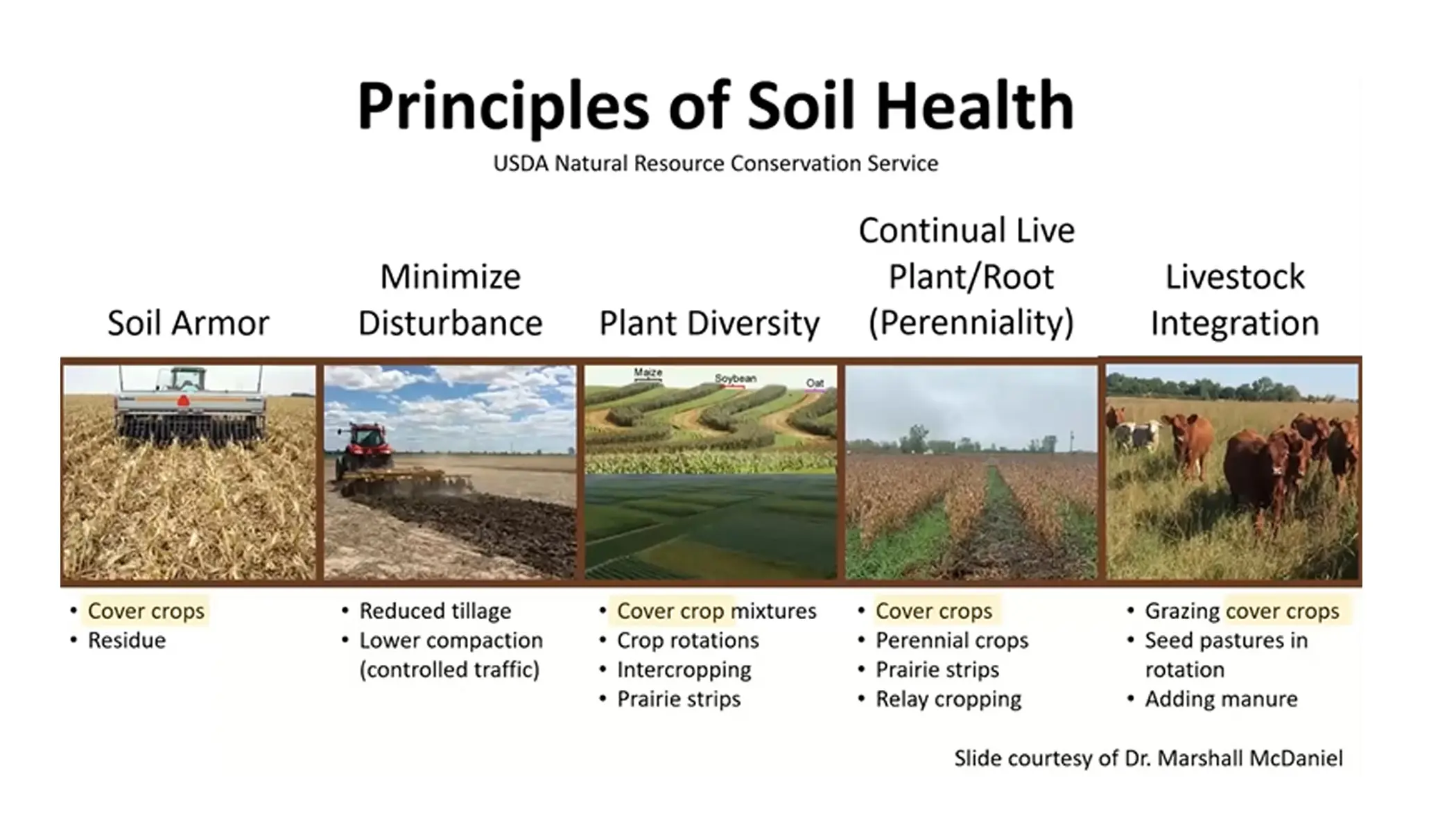
Cover crop and no-till practices are gaining traction in Iowa and across the nation as farmers seek to improve soil health and water quality, but farmers are looking for cost-share opportunities to make continued adoption and expansion economically viable.
Alejandro Plastina, director of the Rural and Farm Finance Policy Analysis Center at the University of Missouri-Columbia and formerly of Iowa State University, says that while adoption of cover crops and reduced or no-till practices is increasing, farmers need economic incentives to continue implementing these practices as crop budgets are squeezed.
“It’s as important to focus on continued adoption going forward as trying to convince farmers to start implementing these practices from scratch,” said Plastina.
“Cover crops (for example) are not profitable for most farmers without cost share payments. Even when we account for cost share, net returns are less negative among program participants, but not all participants experience positive profits.”
No-till or reduced-till conservation practices also can offer significant cost savings, provided yields remain stable, he noted.
“Lower tillage intensity can lead to reduced input costs in labor, machinery and fuel, but estimated yield effects of no-till and reduced tillage can be variable,” Plastina said. “Net profitability varies … Adoption is correlated with decreased cost of production for corn and soybeans.”
Programs such as the Iowa Department of Agriculture and Land Stewardship’s financial incentives for first-time and returning participants implementing cover crops play a critical role, Plastina said.
The federal Environmental Quality Incentives Program (EQIP), which offers financial and technical assistance for conservation measures, is equally important.
“There was an increase in EQIP payments — cost-share payments — for both cover crops and no-till between 2017 and 2022,” Plastina said. “The end payment to the farmer increased between those two points. When we add cost share … , some studies show positive net returns.”
Conservation on the rise
Data shows Iowa farmers are adopting conservation practices ahead of the national average.
The 2024 Iowa Nutrient Research and Education Council (INREC) reports cover crops were planted on 16.7% of Iowa’s cropland in 2024, up from 6.9% in 2017.
INREC reports farmers used no-till on 40.5% of corn and soybean acres in 2024, up from 22.5% in 2017. Nationally, about 27.5% of U.S. cropland adopted no-till in 2022, up from 26.4% in 2017, according the USDA Census of Ag.
Plastina noted there is little doubt that conservation practices improve soil health and water quality, delivering multiple public benefits that justify government cost-share support. Continuing these efforts is critical to maintain current practices and encourage further expansion, he said.
“We like to think in terms of benefits and costs — and not only benefits and costs to the farmers but also benefits and costs to society,” Plastina said.
“There might be the public benefit of reduced soil erosion, improving air and water quality. There might be carbon intensity reductions associated with these soil health management practices in line with 45Z tax credits. Reduced nutrient loss or improved pesticide management improves water quality.
“Increased soil infiltration or water holding capacity could mitigate effects of extreme precipitation events … These practices could increase biodiversity.”
Want more news on this topic? Farm Bureau members may subscribe for a free email news service, featuring the farm and rural topics that interest them most!