World Soybean Meal Trade
Author
Published
8/6/2026
A look at the changing dynamics of the global soybean meal market
Due to its cost-effectiveness and crude protein content, the demand for soybean meal on a global scale continues to expand. As a co-product of soybean oil extraction through crush processes, as domestic crush capacity increases in response to expanding domestic biofuels policy, the production of soybean meal has followed.
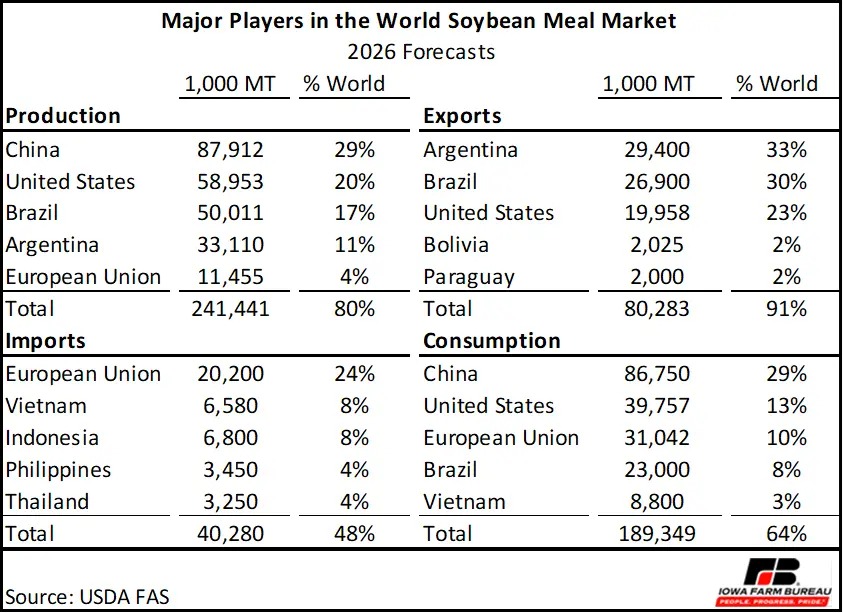
China maintains a sizeable lead as the world’s largest producer of soybean meal accounting for 29% of global production, followed by the United States at 20% of global production. China is also the largest global consumer of soybean meal but is notably absent from the top importers list.
In terms of soybean trade, Argentina is the largest global exporter of soybean meal, accounting for 33% of the global total exports. Notably, Argentina is the fourth largest global producer of soybean meal producing 33.1 million MT annually while exporting 29.4 million MT of soybean meal, suggesting exports account for nearly 89% of annual production. The European Union is the largest global importer of soybean meal, importing nearly 20.2 million MT. Even as the fifth largest producer of soybean meal, the European Union is the third largest global consumer of soybean meal making imports.
Relative Value of US Soybean Meal Imports and Exports
To get a more detailed look at the domestic and global landscape of soybean meal trade, the remainder of this article utilizes UN Comtrade data and is not comparable to data in Table 1.
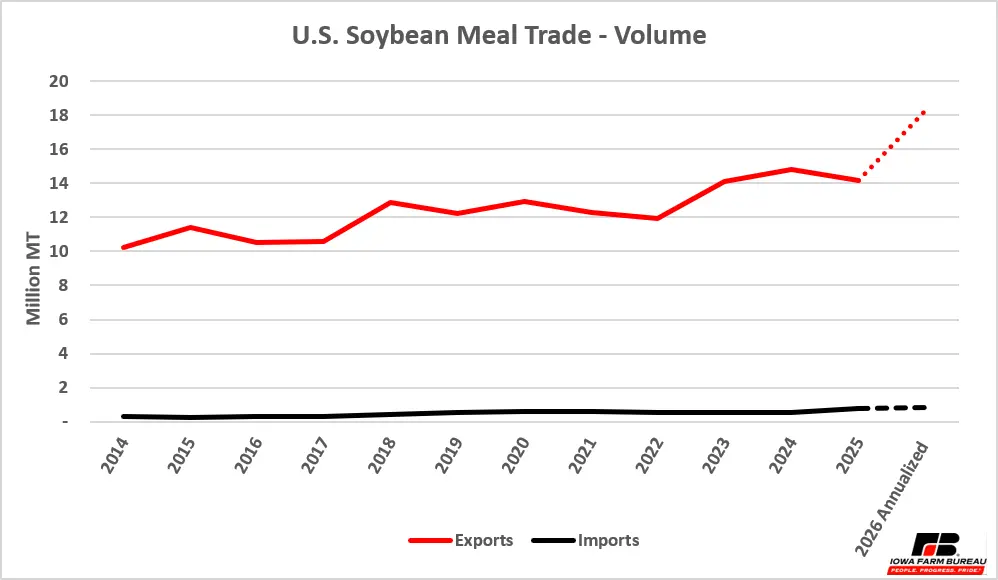
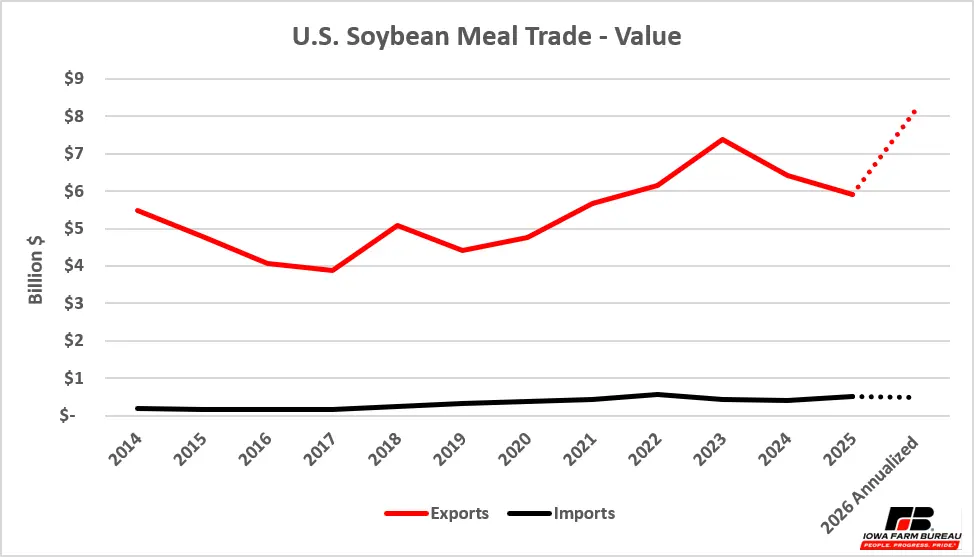
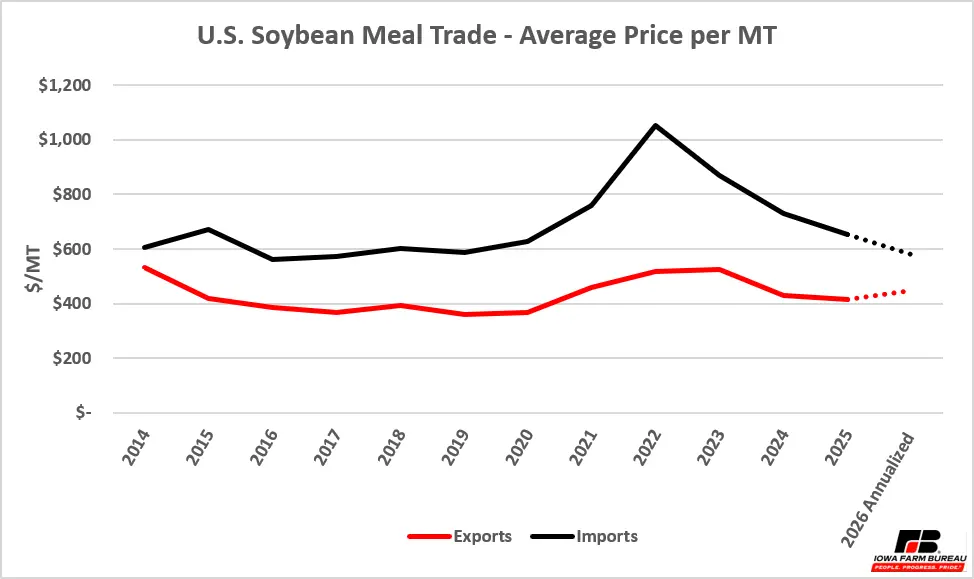
Figure 1 illustrates U.S. soybean meal trade on a volume basis; Figure 2 illustrates U.S. soybean trade on a value basis; and Figure 3 illustrates the average price of soybean meal exports and imports per MT.
Based off of trade data from the first five months of 2025, volume and value of soybean meal exports and imports were annualized for 2026. Notably, both volume and value of soybean meal exports are sizably more than 2025. Annualized export volume for 2026 are an estimated 18.3 million MT, up 29% from last year. For the first five months of 2026, U.S. soybean meal exports totaled 6.6 million MT, up 44% from the first five months of 2025 at 4.6 million MT. The U.S. typically imports very little soybean meal; however, annualized soybean meal imports for 2026 are an estimated 848,547 MT, up 10% from 2025.
Major U.S. Soybean Meal Trading Partners
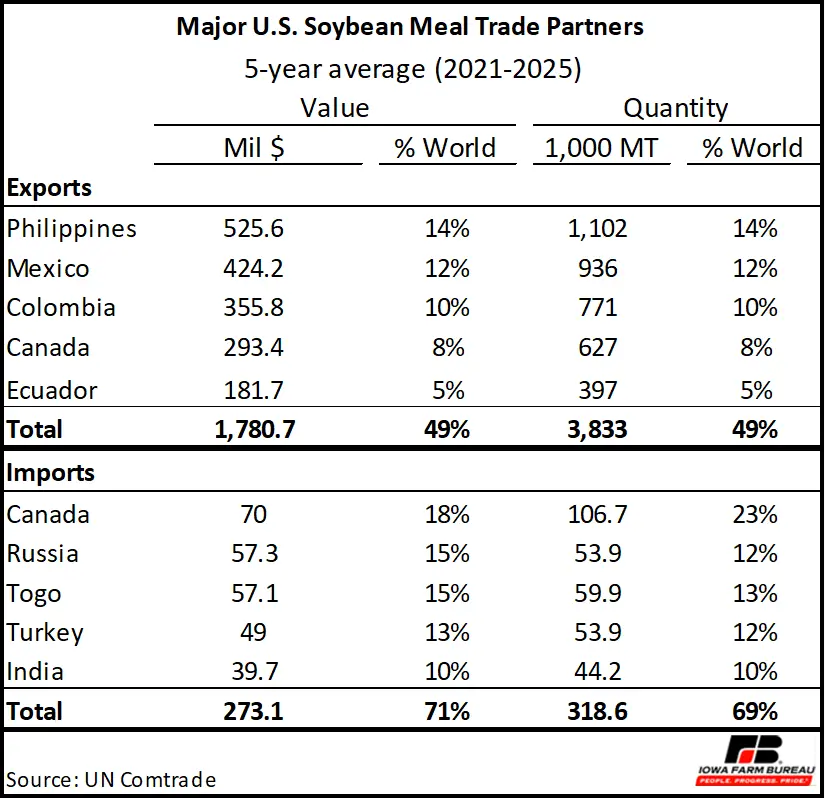
As outlined in Table 2, major export destinations for U.S. soybean meal include Philippines, Mexico, Colombia, Canada, and Ecuador. As the largest purchases of U.S. soybean meal, the Philippines’ expanding livestock, poultry, and aquaculture industries are a primary driver of soybean meal demand. Similarly, Mexico’s demand for soybean meal is driven by livestock and poultry production. Paired with relatively minimal domestic production that account for a very small share of total domestic consumption, Mexico heavily relies on imports to meet soybean meal demand.
While the United States typically imports very little soybean meal, primary suppliers to the United States include Canada, Russia, Togo, Turkey, and India. Canada supplies almost a quarter of U.S. soybean meal imports, on a five-year average basis.
Trade Partners of Other Major Exporters
Other than the United States, there are numerous other major global players in the soybean meal market. Table 3 outlines the trade relationships of Argentina, Brazil, Bolivia, and Belarus – major soybean meal exporters. On a five-year average basis, Argentina is the largest global exporter of soybean meal, with major trading partners in Southeast Asia (i.e. Vietnam, Indonesia, and Malaysia) along with Poland and Italy. Brazil, also a major soybean meal exporter, partners with countries in Southeast Asia, but also with European countries like Germany, Netherlands, and France. Even though Argentina exports a lower volume of soybean meal to its top five trading partners relative to Brazil, Argentina’s total soybean meal exports are around 10% more than that of Brazil.
Bolivia and Belarus are also considered by major soybean meal exports, although by both volume and value are substantially smaller exporters relative to other major exporters. Bolivia exports the majority of soybean meal to South America, with Colombia accounting for over half (57.3%) of soybean meal exports on a five-year average basis. Belarus, on the other hand, exports the vast majority of soybean meal to Russia (83.1%) by volume. Other export destinations include Poland, Ukraine, Germany, and Denmark.
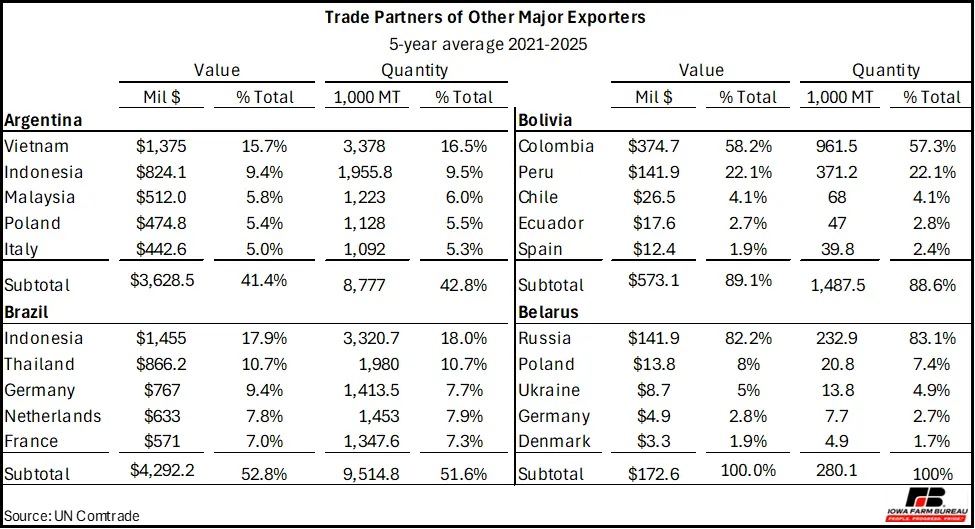
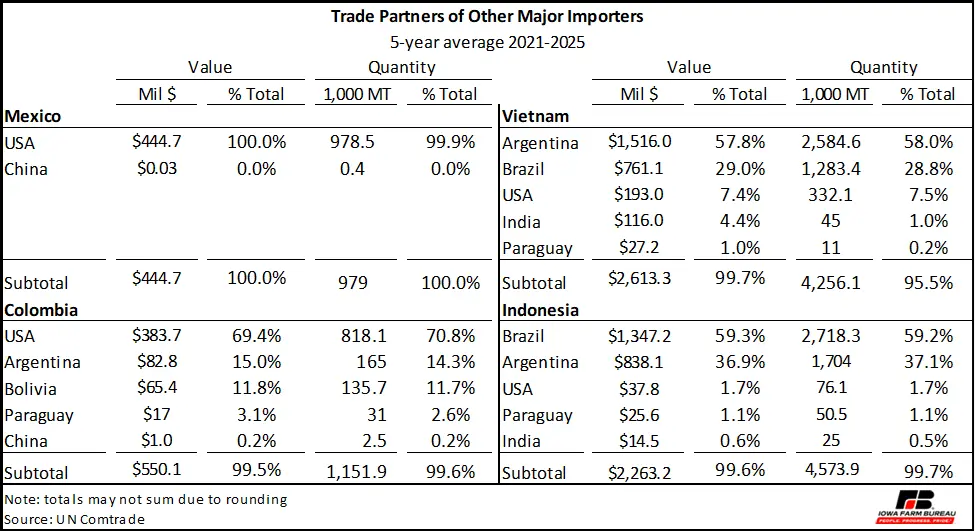
Table 4 highlights the trade partners of major soybean meal importers. Countries in Southeast Asia (i.e., Vietnam and Indonesia) continue to import a majority of soybean meal from South American countries like Argentina and Brazil. The United States is also a major supplier for Mexico, Vietnam, and Indonesia; however the United States supplies nearly all of Mexico’s imported soybean meal, while only supplying 7.5% of Vietnam’s total soybean meal imports and 1.7% of Indonesia’s total meal imports on a five-year average basis.
The dynamics of both the global soybean market have dramatically changed as growth in livestock and poultry production strengthened the demand for cost-effect, high-protein feedstuffs. As a by-product of soybean crush to derive soybean oil, the expansion of biofuels both in the U.S. and around the world has driven crush capacity expansion and production resulting in abundant soybean meal supplies that are advantageous to food, agricultural, and industrial industries worldwide.
Economic analysis provided by Paige Klipstein, Research Analyst, Decision Innovation Solutions on behalf of Iowa Farm Bureau
Find more information about alternative soybean products:
Want more news on this topic? Farm Bureau members may subscribe for a free email news service, featuring the farm and rural topics that interest them most!