Tomorrow’s farm leaders
Author
Published
2/2/2026
Elevated input costs, land access, farm succession and financing are among the biggest challenges facing Iowa’s young farmers as they work to build their families and grow their farming operations in uncertain times.
Young farmers represent the next generation of Iowa agriculture, stepping into an industry facing tight margins, rapid technological change and one of the largest generational land transfers in history.
Approximately 500 young farmers gathered Jan. 23–24 at the annual Iowa Farm Bureau Young Farmer Conference in Des Moines to network, learn and share their thoughts on farming in Iowa.
The event offered opportunities to exchange stories and hear from experts on farm finances, technology, succession and other key issues facing young producers.
For Carroll County Farm Bureau members Brandon and Hannah Kerkhoff, attending their first conference was an excellent opportunity to network, learn and grow. The Kerkhoffs live on Brandon’s generational family farm just outside Templeton, where they custom feed 5,000 hogs, grow corn and soybeans and operate a custom cover crop business.
“Excited to network and learn from other young farmers who are in similar situations as us,” said Hannah. “We (were) most interested in the sessions that discuss the finances of the farm, which can sometimes be a very complex entity, and the ones that (gave) us insight on ways to grow our business.”
Jordon and Kayla Groff, Mitchell County Farm Bureau members, grow row crops and raise beef cattle and meat goats near Osage.
“Agriculture is deeply rooted in our lives, and we hope to carry this tradition forward to the next generation,” said Kayla. “We really enjoy the chance to connect with other young farmers. Networking and real-life conversations are just as valuable as the sessions.”
Nicholas Kaska’s grandfather, Ardell, began farming after returning from World War II and soon moved the operation from Washington County to near Fairfield in Jefferson County, where it remains today. Over the years, the farm has produced corn, soybeans, hay, hogs and cattle. While the operation has since downsized, Nicholas and his father, Don, hope to continue the family’s farming tradition.
A Jefferson County Farm Bureau member, Nicholas said the conference offers opportunities for growth and education, including this year’s tour of the Iowa State University veterinary labs.
“Most of all, I look forward to meeting new people in the ag field (each year),” he said.
Tackling challenges
While young farmers are excited about their future, they admit that breaking into farming and succeeding can be difficult.
Adam Koch’s family has been farming for three generations. He and his wife, Rosie — Mitchell County Farm Bureau members — grow corn and soybeans, raise cattle, and own and operate Kittleson Brothers alongside business partners Steve and Beth Rachut, growing and packing potatoes and onions.
“One challenge we’re facing is available resources to young and beginning farmers,” said Rosie. “While eager to try new practices to improve our farming operation, high prices are often the most limiting factor. Another current challenge in agriculture is the transition of farm ownership from older generations to younger ones … This further stresses the limited number of young farmers returning to multigeneration family farms.”
Chickasaw County Farm Bureau members Josh and Barbara Thiessen agree. They help on the Schwickerath family farm (with Barbara’s father, Neal), and Josh jumped headfirst into the meat goat industry, expanding his herd.
“The amount of U.S. farmland that is expected to change hands in the next 10 to 15 years is massive,” said Barbara. “This could be a challenge for not only young farmers, but the ag industry as a whole.”
Bryan and Crystal Schroeder are Plymouth County Farm Bureau members who live in Remsen, where Bryan farms with his parents and brother, raising hogs. The Schroeders grow row crops and operate custom manure application and drone spraying businesses.
“The increasing land prices and total input costs are a major challenge for anyone, especially the young farmer,” said Crystal. “It is also difficult to find employees to help with all the aspects of farming.”
Fayette County Farm Bureau members Chris and Megan Baumgartner grew up in row-crop and beef operations. They balance farming with off-farm careers in construction and agricultural lending.
Megan said high land prices and competition make owning or securing long-term leases difficult. High start-up costs and needed equipment, mixed with fluctuating commodity prices and input costs, create financial strain for young farmers.
“Makes it tough to squeeze profit margins without having outside assistance from family, neighbors or off-farm income to supplement,” she said.
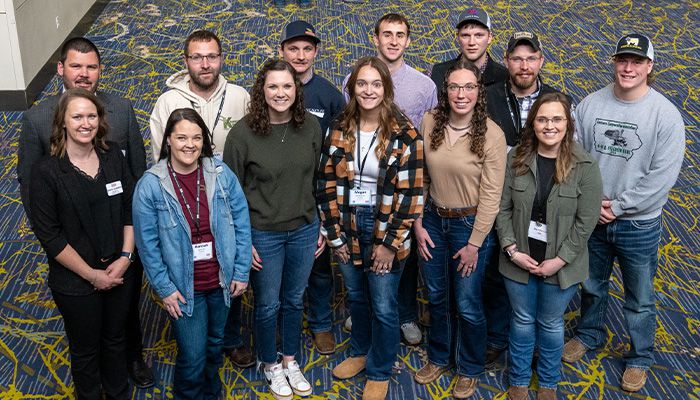
PICTURED ABOVE: Young Farmer Conference attendees sharing their thoughts on farming in 2026 include, left to right, Bryan and Crystal Schroeder, Brandon and Hannah Kerkhoff, Josh and Barbara Thiessen, Chris and Megan Baumgartner, Adam and Rosie Koch, Jordon and Kayla Groff and Nicholas Kaska. PHOTO / CONRAD SCHMIDT
Positive outlook
Yet with challenges come opportunities, the young farmers said. While their operations differ, many young farmers pointed to technology and conservation as key parts of their future plans.
The Groffs see farming changing with more focus on technology, efficiency and sustainability.
“There is still a strong need for family farmers and people who care about the land and livestock,” said Kayla.
The Kochs hope to expand their farming acres and will strive to connect consumers with locally grown products.
“I see the future of farming evolving with more awareness of environmental impacts and pressures,” said Rosie.
The Thiessens hope to raise their family on the farm, build a cattle herd and expand their meat goat operation. Barbara sees artificial intelligence and technology growth playing a role in shaping the future of agriculture.
As an example, “On the livestock side, there are wireless fences that could open the door for those who struggle with pasture ground,” she said.
The Schroeders plan to continue their current farm operations while implementing advances in ag technology, including drones.
“We are excited to see farm life through the eyes of our kids and for our kids to become involved locally with Clover Kids and eventually 4-H,” said Crystal.
Megan Baumgartner said she and Chris hope to achieve a successful farm transition plan for both sides of the family while growing more acres and expanding the availability of the Baumgartner Registered Angus herd brand locally and beyond.
“With larger farmers continuing to increase in size and smaller farms declining, there is a need to diversify the operation,” she said.
Hannah Kerkhoff said it is imperative that, with the average age of landowners increasing, young farmers have a seat at the table in succession planning to continue the legacy. She and Brandon hope to expand their row crop and cover crop businesses.
“Doing this will allow us to provide a legacy to pass down to our children and future generations,” Hannah said. “We truly love the farming life and have a passion for what we do.”
Kaska agreed, sharing his goal to purchase the family farm with his dad while expanding the family’s cattle numbers, focusing mainly on livestock. “Hope to live in and raise a family in the same house as my grandfather,” he said.
Want more news on this topic? Farm Bureau members may subscribe for a free email news service, featuring the farm and rural topics that interest them most!