World Pork Trade
Author
Published
5/14/2026
China continues to dominate global pork production and consumption, while the United States leads global pork exports.
The United States remains in the top 5 for pork production, consumption, maintains its place as the top global pork exporter (Table 1). Projections from the USDA for 2026 indicate that China is expected to continue to outpace the European Union and the United States in pork production and domestic consumption. China’s pork production accounts for half of total global production. The European Union and the United States each account for 11% of global pork production. China’s share of domestic consumption continues to remain above half of total global pork consumption.
Forecasts for 2026 indicate a slight increase in total pork production, exports, imports, and domestic consumption. Mexico is projected to be the top importer of pork, followed by Japan and China.
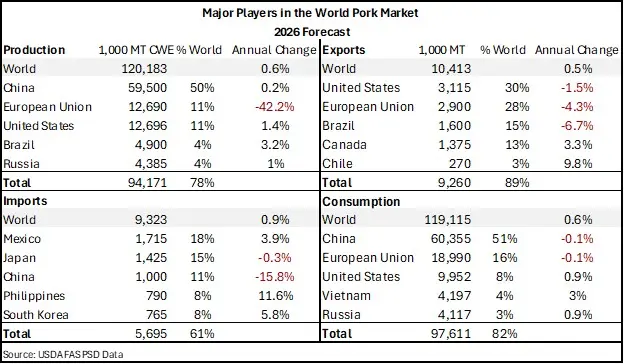
Compared to 2025, global pork production is projected to be higher across major producers except the European Union whose production is expected to decline over 42%. Exports from the two largest suppliers, the United States and the European Union, are projected to be down 1.5% and 4.3%, respectively, relative to 2025. Imports for China are projected to decline by around 15%, while other major importers like the Philippines are forecast to see an 11% boost in pork import volume. Consumption remains largely unchanged from the previous year across major global consumers with only slight declines projected in China and the European Union.
Relative Value of U.S. Pork Exports and Imports
To get a more detailed look into world pork trade, the remainder of this article references UN Comtrade data and is not comparable to Table 1, but the data tells a similar story.
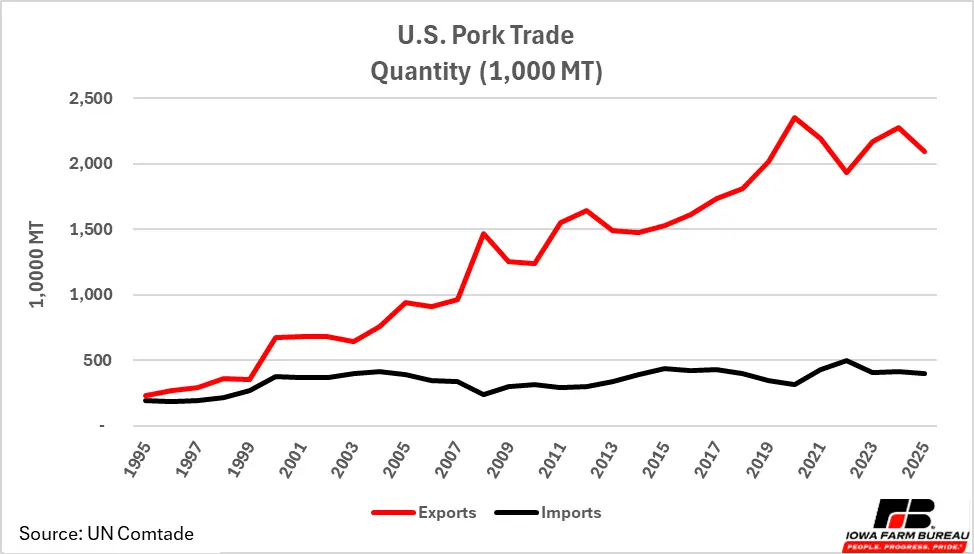
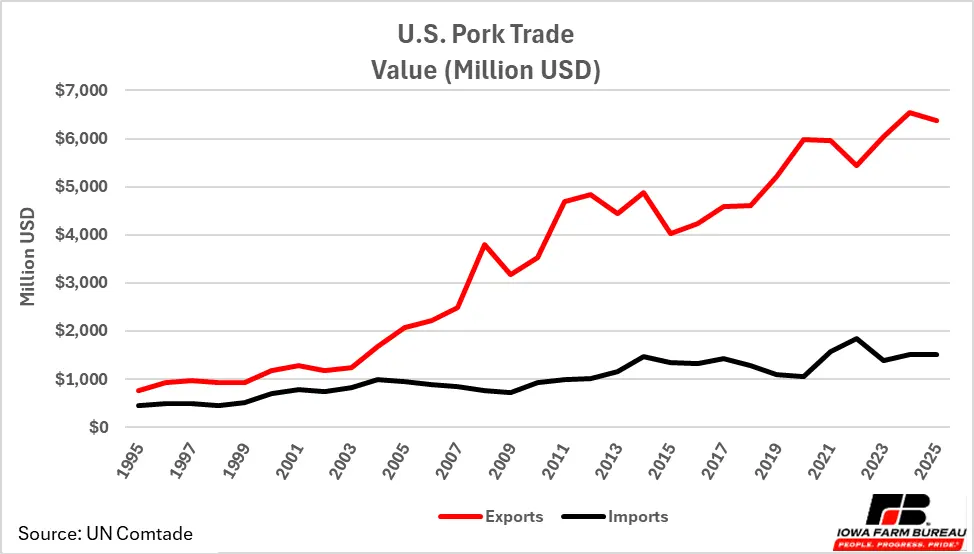
Figure 1 outlines U.S. pork trade by volume over the last three decades. Figure 2 highlights U.S. pork trade by value over the same period. Noticeably, the United States continually imports very little pork. Beginning in the early 2000s, the United States began to ramp up pork exports, and the gap between U.S. pork exports and imports quantity and value continues to widen over time despite small year-over-year changes in pork exports.
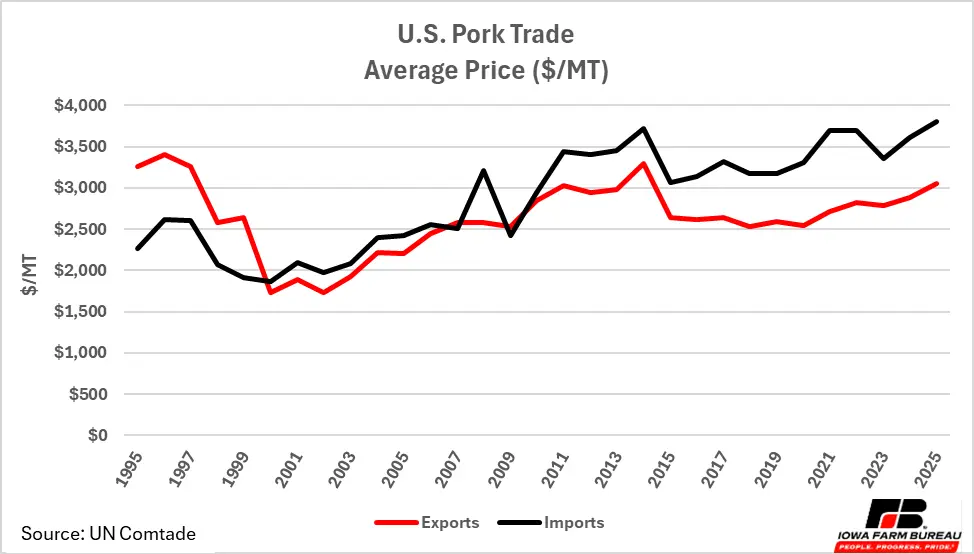
Notice, as illustrated in Figure 3, starting in the mid-2000’s the average price of U.S. pork exports has been typically lower than the price of imports suggesting that the United States tends to import premium or higher-value cuts like processed pork products; whereas pork exports are typically lower-value cuts like variety meats (offal).
Major Trade Partners for United States Pork
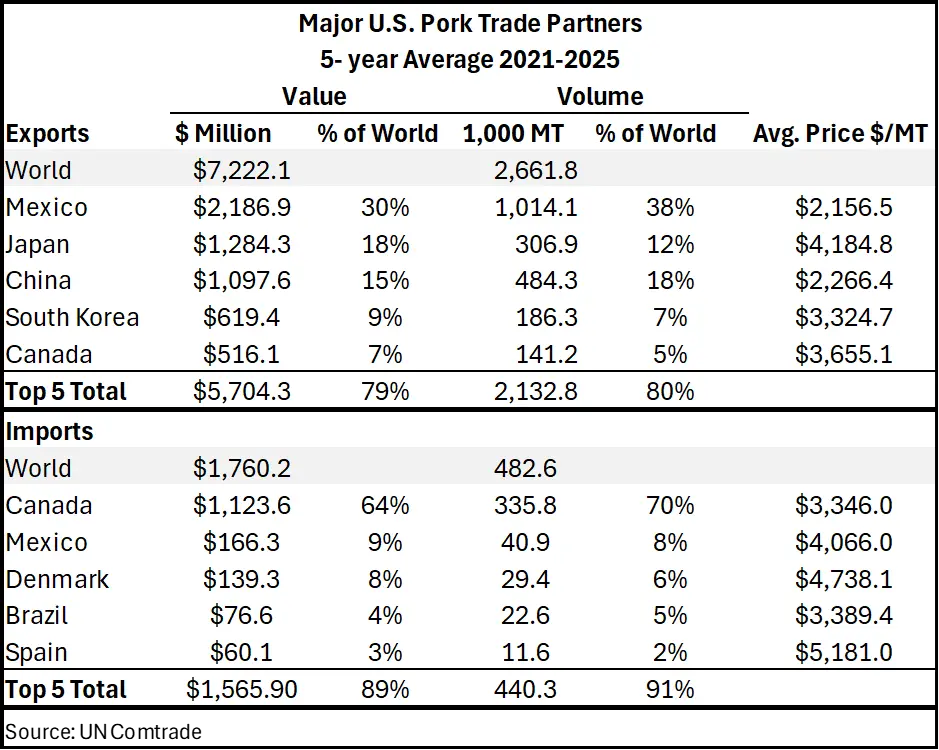
Over the last five years, Mexico has remained the top export destination for U.S. pork. On average over the last five years, Mexico accounts for 38% of U.S. pork export volume (Table 2). On a five-year average basis, Japan has jumped above China becoming the second largest export destination of U.S. pork. Exports to China have declined nearly 17%, on a five-year average basis largely driven by China’s retaliatory tariffs that have slowed pork exports to China throughout the past year.
Canada continues to be the largest supplier of pork to the United States, accounting for 70%, on a five-year average volume basis. Mexico supplies around 8% of U.S. pork imports followed by Denmark, Brazil, and Spain who each account for less than 7% of pork supplied to the United States. The top 5 suppliers of pork for the United States account for 91% of total pork imports.
Trade Partners of Other Major Exporters and Importers
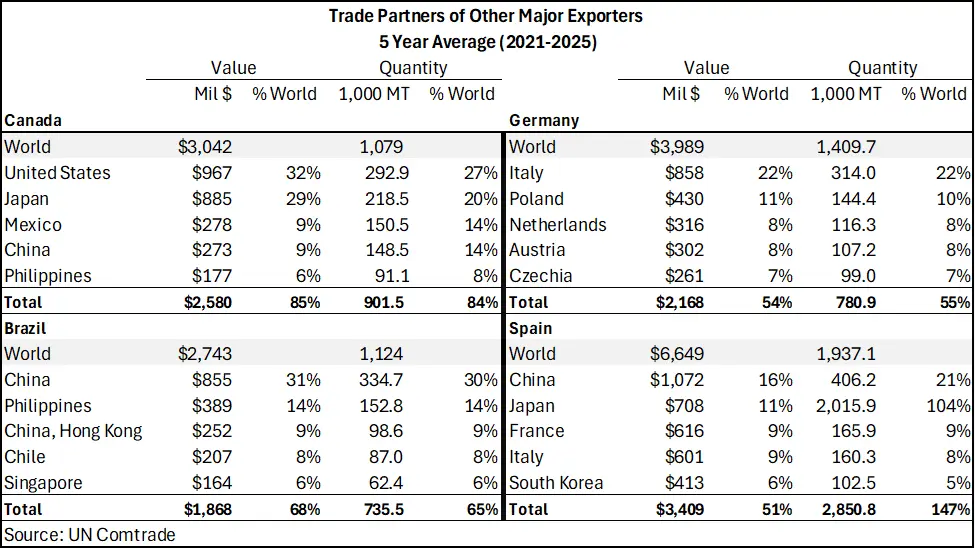
The global pork market is comprised of many countries other than the United States that influence global trade dynamics. As highlighted in Table 3, Canada, Germany, Brazil, and Spain are also major exporters of pork. On a five-year average basis, Canada has exported around 1.1 million MT of total pork with the United States purchasing 27% of total export volume. Italy is the largest purchaser of pork from Germany. Collectively, the European Union sees a significant amount of pork trade, both exports and imports, among member countries.
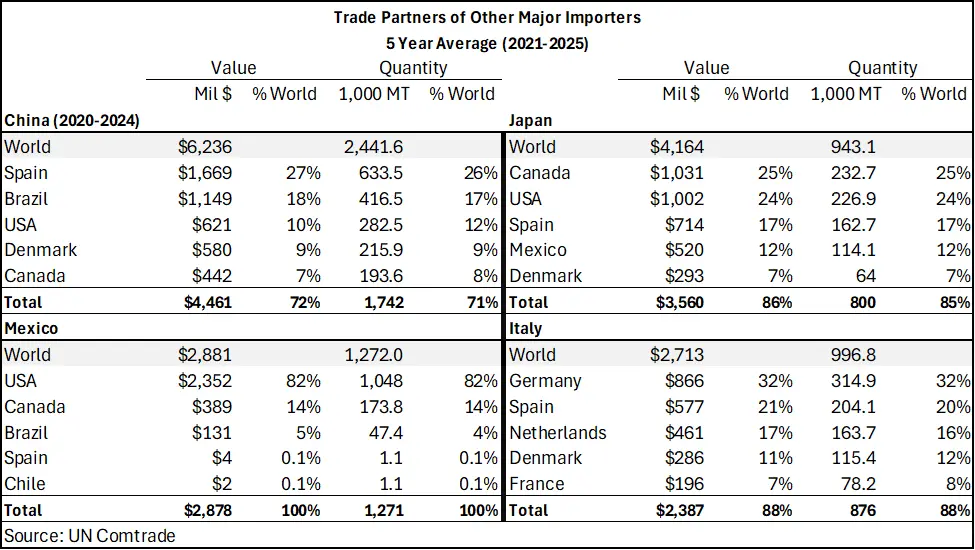
China remains the largest global importer of pork. Although China’s 2025 Comtrade data is not available, from 2020 to 2024, nearly 26% of all China’s pork imports were purchased from Spain. China, on average, imports over 2.4 million MT of pork annually valued at $6.2 million. Japan and Mexico are two other major importers of pork, with the majority of their imports supplied from Canada and the United States. Combined, Canada and the United States supply nearly 50% of Japan’s pork imports while the Untied States supplies around 82% of Mexico’s pork purchases. Unsurprisingly, Italy’s major pork suppliers are members of the EU, with Germany supplying around 32% of Italy’s total pork imports.
Economic analysis provided by Paige Klipstein, Research Analyst, Decision Innovation Solutions on behalf of Iowa Farm Bureau
Find more information about World Commodity Trade:
Want more news on this topic? Farm Bureau members may subscribe for a free email news service, featuring the farm and rural topics that interest them most!