World Beef Trade
Author
Published
10/20/2026
The domestic cattle herd in the U.S. has face enormous pressures related to herd consolidation and high prices coupled with persistent consumer demand and uncertain trade implications.
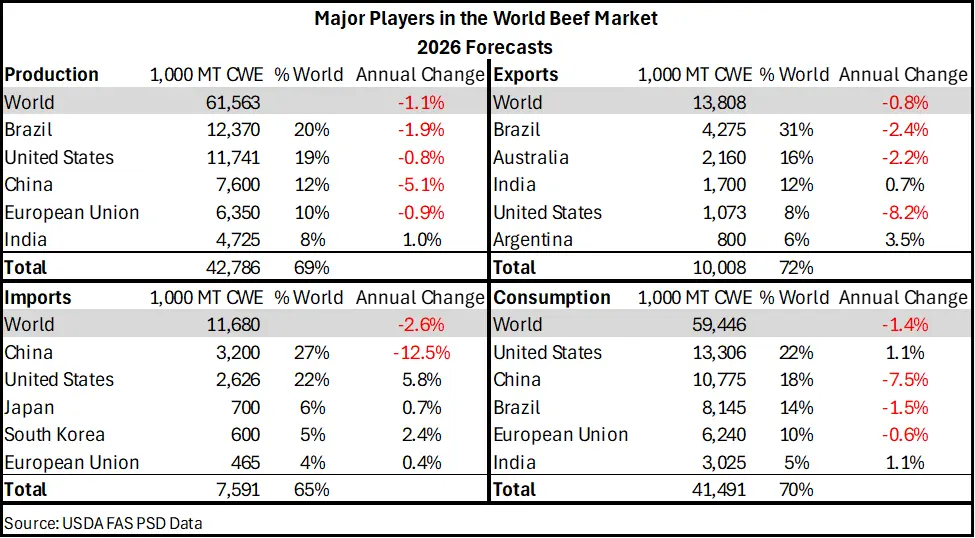
On a global scale, the United States continues to be a major player in the global beef market dominating global beef consumption. Brazil is expected to be the largest producer, a spot that recently belonged to the U.S., and exporter of beef and veal.
In terms of trade, China leads in beef imports at 3.2 million MT, closely followed by the United States at 2.6 million MT.
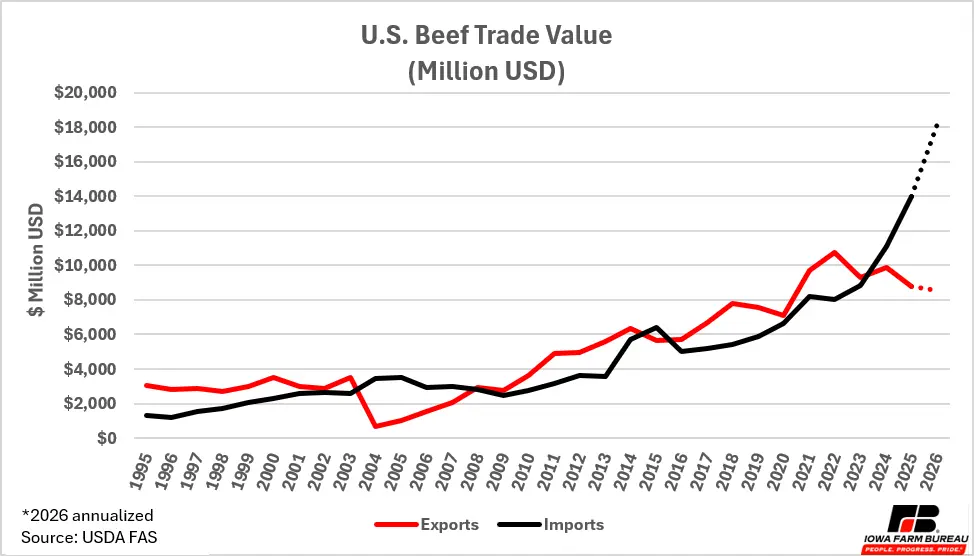
Relative Value of U.S. Beef Imports and Exports
The remainder of this articles utilizes data from UN Comtrade and is not comparable to USDA data outlined in Figure 1.
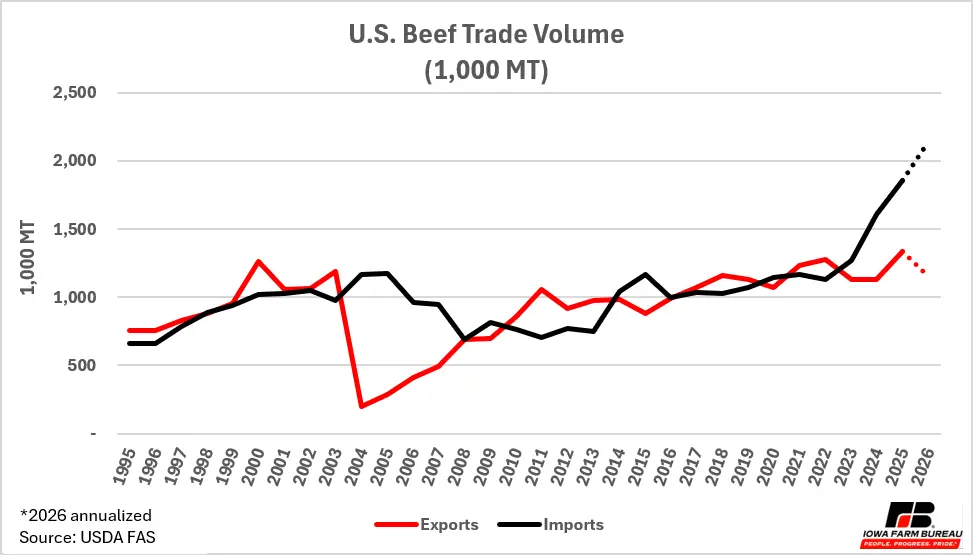
Typically, U.S. beef exports and imports are relatively equal. The widening gap between exports and imports indicate that current trends in beef exports and imports reveal that beef imports, by both volume and value, are projected to keep rising while exports tend to trend downward. Note that data for 2026 is annualized based on the first seven months of 2025.
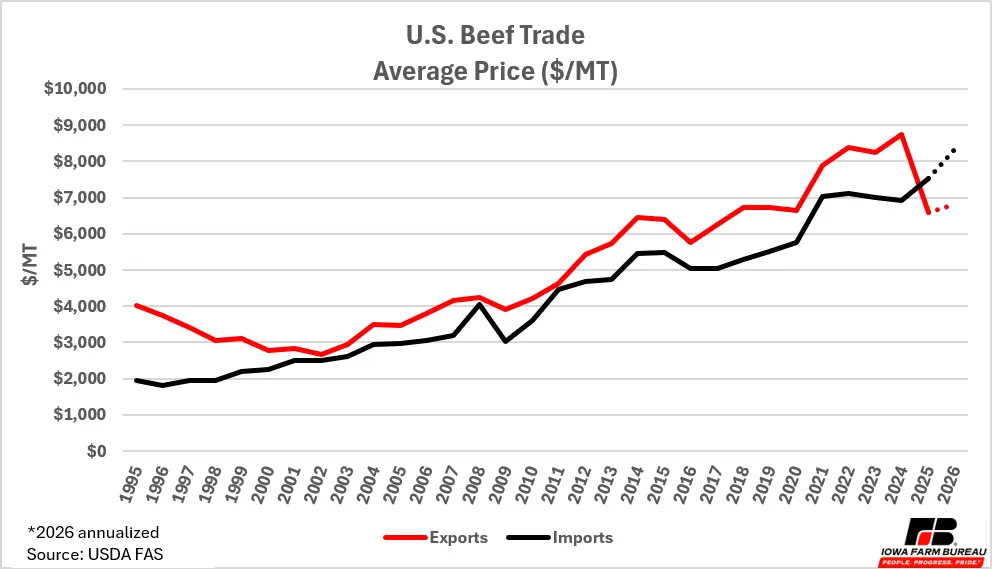
Average price of exports throughout the last three decades have largely remained above the average price of imports. Outlined in Figure 4, the average price of imports rose above that of exports in 2025. Annualized data for 2026 indicates that trend my persist throughout the rest of year putting average export prices at $6,806/MT and average import prices at $8,315/MT.
Major Trade Partners for U.S. Beef
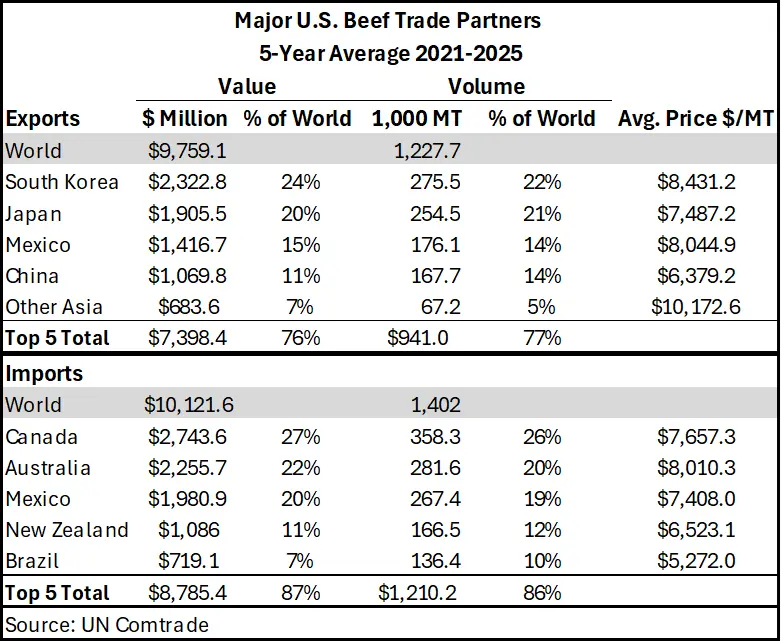
South Korea and Japan continue as the two largest markets for U.S. beef exports, collectively accounting for 43% of total U.S. beef exports by volume. Mexico and China are also major export markets, each accounting for 14% of total U.S. beef imports, on average, over the last five years (Table 2).
Over the last five years, on average, the U.S. has imported nearly 1.4 million MT of beef, with 26% supplied by Canada followed by 20% from Australia. As previously mentioned, on average, the U.S. imports slightly more beef than it exports. Domestic supplies due to herd consolidations have had ripple effects not only in market for domestic consumers, but the export market as well. The U.S. typically imports lean cuts to grind into ground beef due as imported beef tends to be leaner relative to what is fed and produced domestically.
Markets of Other Major Importers and Exporters
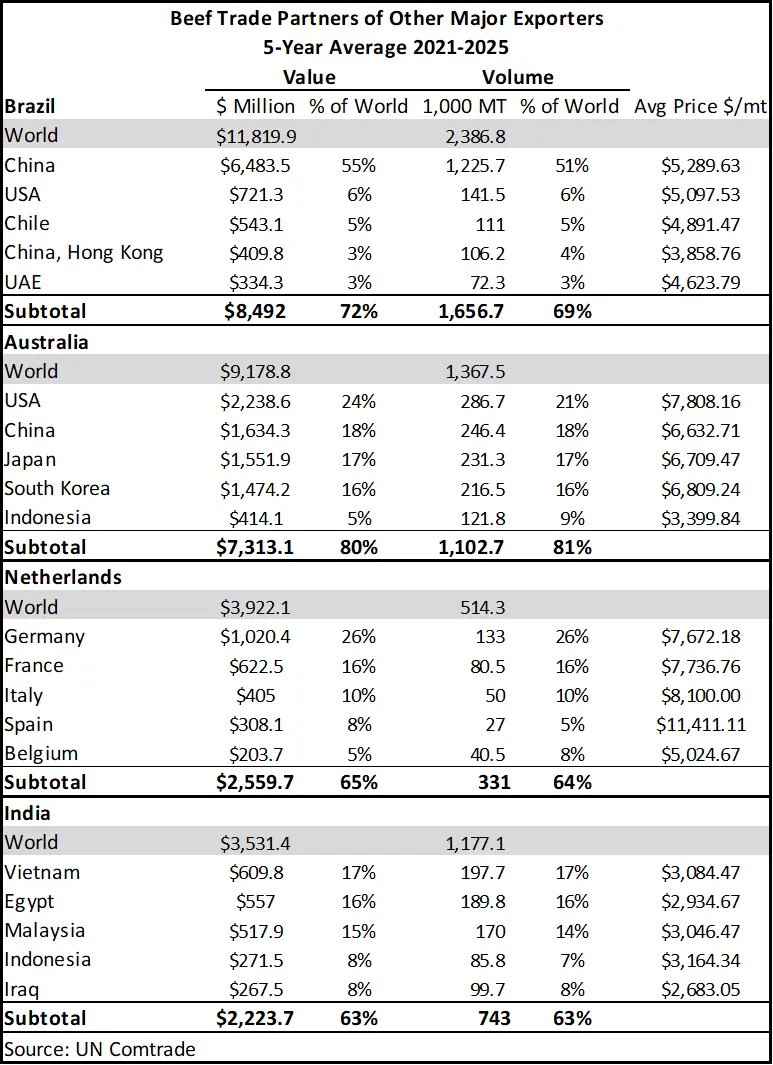
Brazil continues to dominate the global beef export market, exporting, on average, 2.4 million MT annually over the last 5 years. China, Brazil’s primary beef export market, account for over half of their annual beef exports (Table 3). For perspective, the U.S. is Brazil’s second largest export market accounting for 6% of their total annual beef exports followed by Chile, Hong Kong, and the United Arab Emirates each accounting for 5% or less of annual beef exports.
Australia exports approximately 1.4 million MT of beef annually, with 21% of exports to the U.S. and 18% of total beef exports to China. Other major beef export markets for Australia include Japan, South Korea, and Indonesia.
The Netherlands, although still a major beef exporter, export nearly 514,000 MT of beef annually, with primary export partners being other EU counties such as Germany, France, Italy, Spain, and Belgium accounting for 64% of the country’s total annual average beef exports.
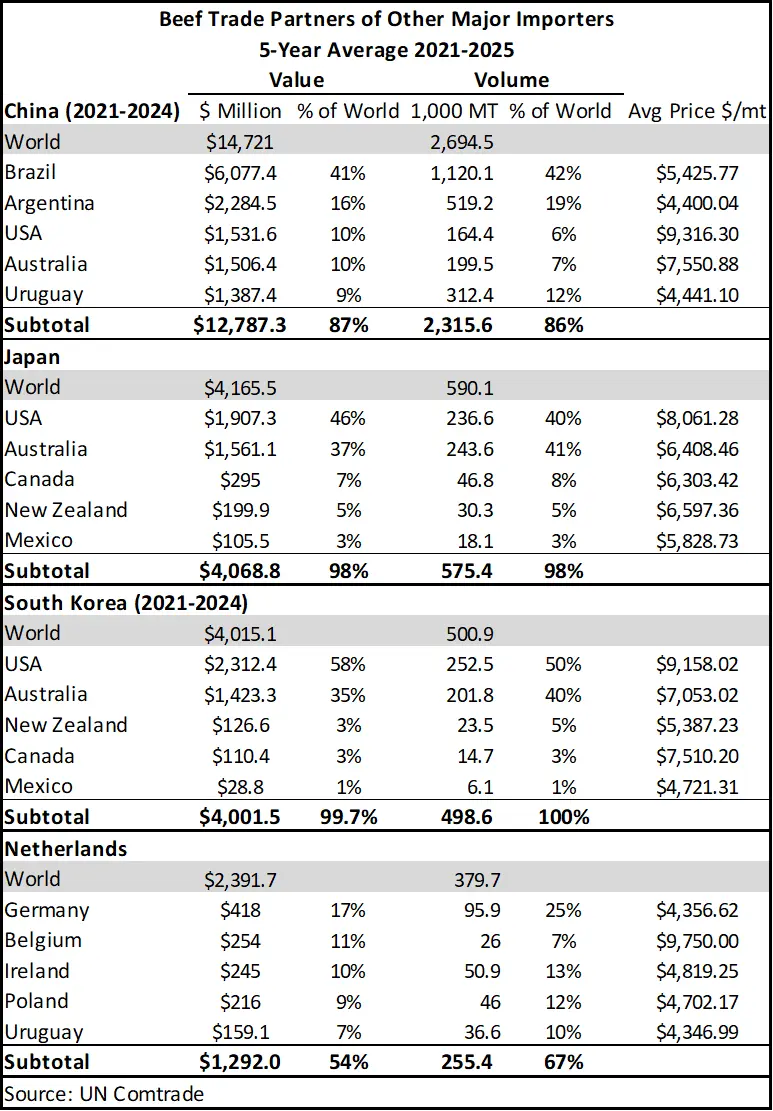
China remains the largest importers of beef, with 42% of imports supplied from Brazil. Japan imports the over 80% of total beef imports from the U.S. (40%) and Australia (41%) on a volume basis (Table 4).
South Korea sources half (50%) of its beef imports from the U.S.; these imports account for 58% of the country’s total annual beef port value. Similar to Japan, Australia supplies South Korea with 40% of total beef imports, followed by New Zealand, Canada, and Mexico. While India has the second largest export volume out of other major exporters other than the U.S., the average value of exports is lower than other major exporters.
Current Trade Status
Although 2026 data currently covers only the first seven or eight months of the year, January through July or August, depending on the country, they still provide meaningful insight into evolving global beef trade trends.
During the first eight months of 2026, Brazil exported nearly 2.04 million MT of beef, while Australia exported 1.3 million MT. In 2025, Brazil exported 66% of its annual beef exports during the same period while Australia exported 71% of annual beef exports. If the remainder of 2026 holds the same assumptions as 2025, that would estimate Brazil’s total beef exports for the year at 3.08 million MT and 1.78 million MT for Australia.
For the first seven months of the year, the U.S. ranks as the largest beef importers with imports totaling nearly 1.3 million MT. Japan follows at the second largest importers at 385,667 MT. Comparatively, monthly U.S. beef imports outpace that of Japan by an average of 127.1 million MT per month. For the first eight months of the year, Japan imported 63% of annual beef imports. If the remainder of 2026 holds the same assumptions as 2025, that would suggest that Japan’s 2026 total beef imports would total 535,648 MT, approximately three times less than the U.S.
For U.S. trading partners, South Korea and Japan remain the two largest export destinations, with exports totaling 186,863 MT and 131,566 MT, respectively. Australia and Brazil are the top two suppliers of beef to the U.S. accounting for 307,171 MT and 211,453 MT, respectively. Annualized data for 2026 using data from the first seven months of 2025 estimate that Australia would become the largest supplier of beef to the U.S. at 464,410 MT, followed by Canada (285,813 MT) and Mexico (275,729 MT).
Economic analysis provided by Paige Klipstein, Research Analyst, Decision Innovation Solutions on behalf of Iowa Farm Bureau
Find more information about World Commodity Trade:
Want more news on this topic? Farm Bureau members may subscribe for a free email news service, featuring the farm and rural topics that interest them most!