Planting Progress Report: May, 2026
Author
Published
5/14/2026
Days suitable for fieldwork during the four-week period from mid-April to early May were generally favorable across much of the Corn Belt and Great Plains despite rainy and stormy conditions. In Iowa, frequent precipitation during April significantly reduced the number of suitable fieldwork days early in the planting season. Statewide precipitation during the first week of April averaged more than triple normal levels, while additional storm systems throughout mid-April brought another 3 to 5 inches of rainfall across portions of the state. Cooler soil temperatures early in the month, combined with saturated soils, delayed widespread planting activity and limited early corn and soybean progress. Iowa reported 13.8 suitable days, down from 16.9 during the same period in 2025 and well below the strong conditions observed in 2020 and 2021 when conditions exceeded 18 and 21 days respectively.
Nebraska stood out with exceptionally favorable field conditions, recording 23 suitable days in 2026. While slightly below the 23.2 days reported in 2023 and 2025, Nebraska remained well above the national average and continued a multi-year trend of strong spring field accessibility. Illinois recorded 15 suitable days, an improvement from 12 days and 10 days reported in 2025 and 2024 respectively. Nationally, there have been 19 days suitable for fieldwork, following the trend seen last year (Figure 1).

Figure 1. Days Suitable for Fieldwork (4 weeks) 2017-2026
Crop Progress
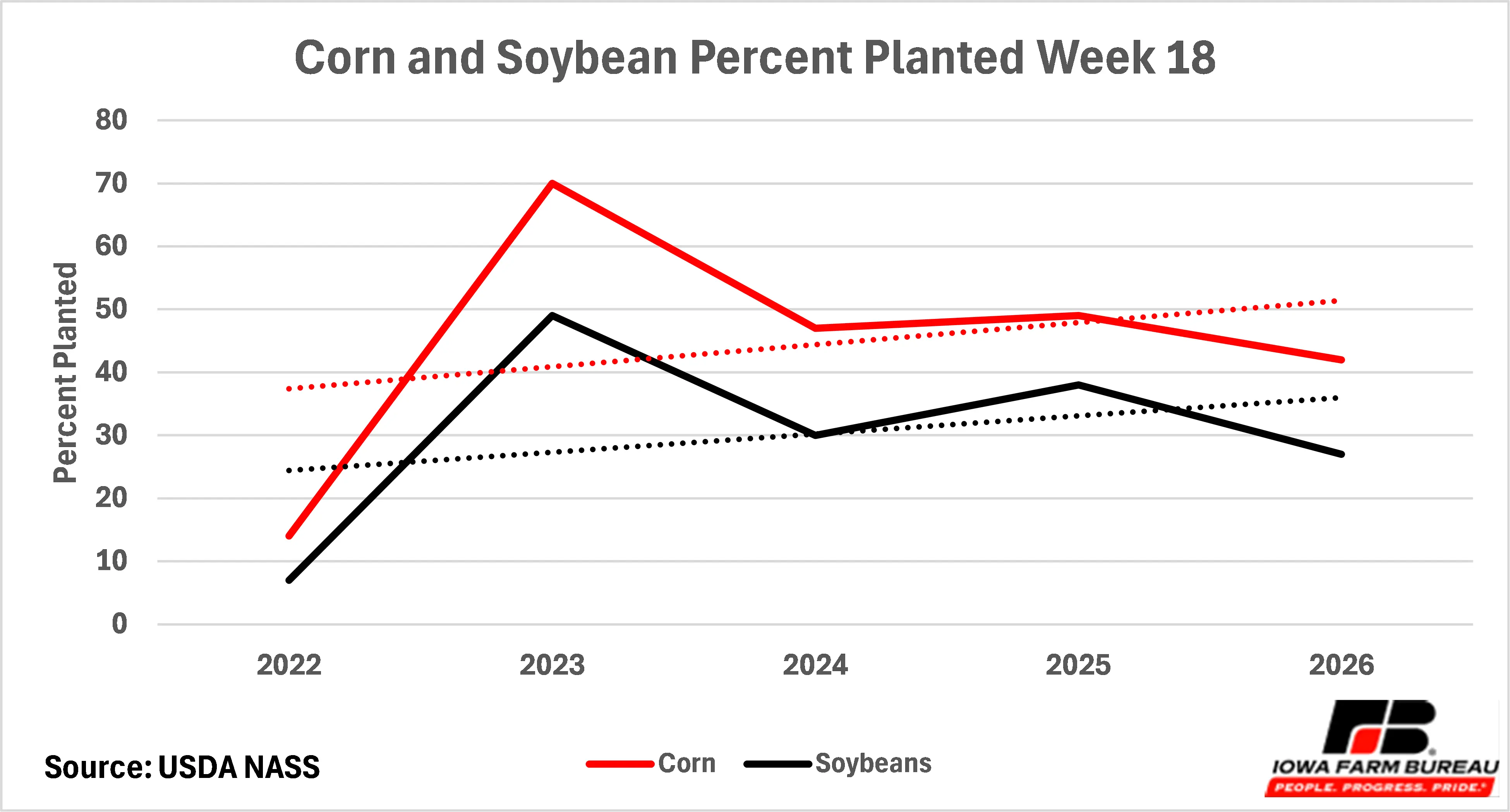
For the week ending on May 3rd, 2026, the percent of corn planted in Iowa surged to 42%, a 25% increase from the previous week. This is down 5% from the same period last year and down 2% from the five-year average. Nationally, corn acreage planted increased by 13% to 38%, surpassing the five-year average (Figure 2).
In the past week, soybean planting increased by 11% to 27%. However, this is 9% behind the pace set last year and slightly below the five-year average of 29% for the 18th week of the year (Figure 2).
Figure 2. Iowa Corn and Soybean Planting Progress at Week 18
Planting progress in Iowa started slowly compared to neighboring states, reflecting the wetter conditions experienced during early April. Iowa reported just 1% planted by April 12 and only 2% by April 19. However, planting activity accelerated significantly during the second half of April as weather conditions improved. By April 26, Iowa reached 22% planted, before nearly doubling to 42% by May 3. This rapid increase suggests producers were able to take advantage of narrow fieldwork windows and favorable weather late in the period (Figure 3).
Nationally, U.S. corn planting reached 38% complete by May 3rd, up sharply from 25% the previous week and more than tripling the 11% reported on April 19th. Among notable states, Missouri has set the fastest planting pace, already eclipsing 50% complete, an 11% from the previous week. Nebraska saw progress advance by 17% to 43% complete and Illinois jumped 8% to 38% complete.

Figure 3. Corn Planting Progress 2026
Corn emergence in Iowa remained limited through early May 2026 despite substantial planting progress during the second half of April. Iowa reported virtually no corn emergence through April 26 and reached only 2% emerged by May 3 (Figure 4). The slow emergence pace reflects the cool temperatures and delayed planting conditions experienced across much of the state during April. Continued warmer temperatures during May will be important for promoting more uniform emergence and stand establishment across Iowa.
Nationally, U.S. corn emergence reached 13% by May 3, up from 7% the previous week and 4% on April 19. Emergence progress remained relatively slow through much of April due to widespread precipitation and cool weather across major corn-producing regions. However, improving weather conditions during late April allowed both planting and emergence activity to gradually increase entering May. Among other notable states, Missouri is leading in corn emergence percentage throughout the reporting period. Missouri reached 11% emerged by April 19 and increased to 32% emerged by May 3, supported by earlier planting windows and warmer spring temperatures. Illinois also showed strong improvement, rising from 1% emerged on April 12 to 24% by May 3 as producers benefited from improved field conditions late in the month.
Kansas recorded similarly steady gains, with corn emergence increasing from 3% on April 19 to 20% emerged by early May. In contrast, northern states continued to lag behind. Minnesota and South Dakota each reported only 3% emergence or less by May 3, while Nebraska reached 7% emerged despite significant planting acceleration during late April.

Figure 4. Corn Emergence 2026
Iowa soybean planting progress started particularly slowly, mirroring the wet conditions experienced during early April. Iowa reported no soybean planting activity through April 12 and only 1% planted by April 19 (Figure 5). However, producers rapidly increased field activity during the final two weeks of April, with planting progress climbing to 11% by April 26 and reaching 27% by May 3rd. While still trailing Illinois and Nebraska, the pace of planting accelerated considerably once weather conditions improved.
Nationally, U.S. soybean planting reached 33% complete by May 3rd, up from 23% the previous week and nearly tripling the 23% reported on April 19th. Illinois is leading the soybean planting pace, reaching 46% complete by the beginning of May, a 10% increase from April 26th. Nebraska also showed a sharp acceleration in planting progress, increasing from just 2% on April 19th to 40% by May 3rd.

Figure 5. Soybean Planting Progress 2026
Soybean emergence in Iowa remained extremely limited through early May 2026, reflecting the delayed planting pace and cool, wet conditions experienced throughout much of April. Iowa reported no measurable soybean emergence through April 26 and reached only 1% emerged by May 3 (Figure 6). While soybean planting accelerated rapidly during the second half of April, crop emergence lagged significantly due to cool soil temperatures and saturated field conditions.
Nationally, U.S. soybean emergence reached 13% by May 3, up from 8% the previous week. Similar to corn, soybean emergence progressed slowly during April due to repeated rainfall events and below-normal temperatures across much of the Midwest and Great Plains. Improved weather conditions during late April helped support gradual emergence gains entering May, although development remained in the early stages across many major production regions.
Illinois continued to lead soybean emergence progress among the states included in the dataset. Emergence in Illinois reached 15% by April 26 and advanced to 26% by May 3, reflecting earlier planting activity and more favorable growing conditions during late April. Missouri also maintained relatively strong progress, reaching 16% emerged by early May after steady gains throughout the reporting period.

Figure 6. Soybean Emergence 2026
The USDA reports that 81% of the state’s topsoil moisture was adequate and another 9% as surplus. Only 10% of topsoil moisture was categorized as short or very short, including just 1% rated very short.
Compared to 2025, Iowa entered the 2026 planting season with slightly improved soil moisture conditions. Adequate moisture ratings increased from 76% in 2025 to 81% in 2026, while very short conditions declined from 3% to 1%. Surplus moisture ratings decreased modestly from 12% to 9%, suggesting soil remained sufficiently moist overall without becoming excessively saturated across most areas.

Figure 7. Iowa Topsoil Moisture at Week 18
Want more news on this topic? Farm Bureau members may subscribe for a free email news service, featuring the farm and rural topics that interest them most!