Ag Innovation semifinalists hone their business ideas
Author
AFBF’s competition has helped Josh Jeske and Caleb Renner improve and grow their businesses while offering networking opportunities and essential feedback.
Iowa agricultural entrepreneurs Josh Jeske of Terraform Tillage and Caleb Renner of Renner Ag Solutions said their experience as top 10 semifinalists in the 2026 Ag Innovation Challenge, sponsored by the American Farm Bureau Federation (AFBF), has provided them with the opportunity to learn, grow their businesses and connect with industry leaders through networking and feedback from judges.
“To make the top 10 in such a prestigious, nationwide competition is really such an honor,” said Jeske. “When you look at the competition … just the quality of the contestants was fantastic … It’s even more humbling.”
Renner agreed, saying he was pleasantly surprised and excited by the honor. “Shocked and also very humbling,” he said. “I live a quiet life here on the farm … and sometimes fail to recognize that what I’m working on does have the potential of being a widespread technology that can help farmers nationally, globally.
“It made me realize that what I’m doing is bigger than myself and also that I still have a lot of work to do.”
Both Jeske and Renner presented their business concepts to a panel of judges in a virtual first-round pitch competition this fall, which narrowed the field from 10 to four.
The four finalists — CryBio of New York, FarmSmarter.ai of Louisiana, KiposTech of Pennsylvania and Vivid Machines of Washington — were announced in September. They will compete for a $100,000 top prize at the AFBF convention in Anaheim, California, in January 2026.
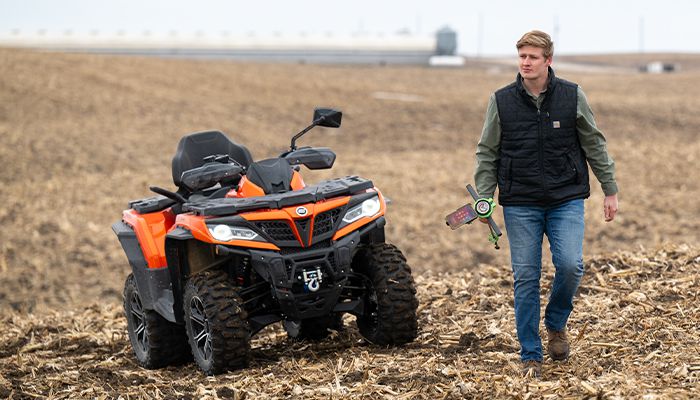
PICTURED ABOVE: Josh Jeske developed the SmartProbe System, a handheld soil penetrometer paired with smartphone technology that allows growers to map fields and measure compaction for effective management decisions. PHOTO / CONRAD SCHMIDT
Terraform Tillage
For the two Iowa companies, being recognized by AFBF is validation that their innovation and hard work are making an impact.
Jeske began exploring soil compaction in 2020 after noticing that more than a century of conventional farming on his family’s central Iowa farm near Eldora had left the soil noticeably lighter.
“We were prone to losing yield to erosion and droughts,” he explained. “So I started researching soil compaction and found that there weren’t very good tools on the market to determine whether we really had a soil compaction issue worth trying to fix … or where we could cut back and save on all those costs and maybe improve the health of our soil long term.”
Finding no effective tools available, Jeske set out to build one. Over the next several years, he developed the SmartProbe System, a handheld soil penetrometer paired with smartphone technology that allows growers to map fields, measure compaction and make data-driven management decisions.
The patent-pending system improves traditional penetrometer mapping by allowing farmers to record readings and generate real-time maps showing yield-limiting soil compaction at various depths.
“I’ve likely poked this thing in the ground maybe more than anyone else on the planet the last few years,” Jeske joked. “We want to be able to map it in real time and start to really fine tune our management and our adjustments across the field.”
The results have led to significant changes on his farm.
“We went from essentially full conventional to only doing subsoiling on the acres that we detected soil compaction levels in,” Jeske explained. “In the last few years, I’ve had near or record yields across the board … along with the lowest tillage input costs on record.
“It’s been fantastic for our farm. We’ve saved so much time and fuel and maintenance and repairs on tillage that we weren’t getting benefit from to begin with, and now to see our yields just climbing and climbing. Our lowest performing fields are starting to become some of our best performing fields.”
Renner Ag Solutions
Like Jeske, fifth-generation farmer Caleb Renner of Klemme saw an opportunity to improve safety and efficiency on the farm. Renner developed a replacement for bin sweeps called AgriNet, designed to make grain bin unloading both safer and more effective.
The design uses nets to push grain toward the center of the bin, eliminating the need for farmers to enter during load-out — a leading cause of farm fatalities each year. The company also plans to develop additional products to enhance grain storage and handling safety.
The idea came to Renner while cleaning out grain bins, a chore he admittedly doesn’t enjoy. His grandfather lost two fingers in a grain bin accident, and a good friend nearly lost a leg from bin sweeping.
“I think that’s probably what will motivate others to look at it … the safety … and the savings on labor,” he said. “What I’m trying to do is gradually change the angle of repose of grain inside the grain bin so the farmer no longer has to enter.
“He can just stand outside and watch a camera and click buttons, which will lift up a net incrementally, causing the grain to trickle into the center sump all by itself with just gravity.”
Company growth
Both Terraform Tillage and Renner Ag Solutions are looking ahead with optimism. Jeske said the SmartProbe System now has more than 250 users across 33 countries, and its versatility continues to surprise him.
“It’s not just our Iowa friends and family who are doing corn and beans … It’s people all over the world in agroforestry, food and produce,” he said. “Golf courses have been a surprisingly big market for us as well.”
He added that conservation methods that help manage compaction and control erosion benefit farmers globally.
“I want to be able to drive around and see more cover crops and see more no-till and know that the soil is going to be sticking around for the next generation and not flying to the next state over when we get a bad wind or washing down into the water,” he said.
Renner has been refining his prototype and plans to test his latest developments in the next few months. Farmers he has visited have overwhelmingly responded positively to the product and want to learn more.
“By 2026, in a perfect world, I hope to be developing my product more, while also conducting pilot programs with farmers in the area,” Renner said. “I’ve never regretted sticking my neck out with an idea that’s creative oriented … or taking that big jump. So far this has been an exciting journey.”
Want more news on this topic? Farm Bureau members may subscribe for a free email news service, featuring the farm and rural topics that interest them most!