Farmland values inch up in market readjustment
Author
Published
12/22/2025
Support the market but weren’t enough to produce broad growth.
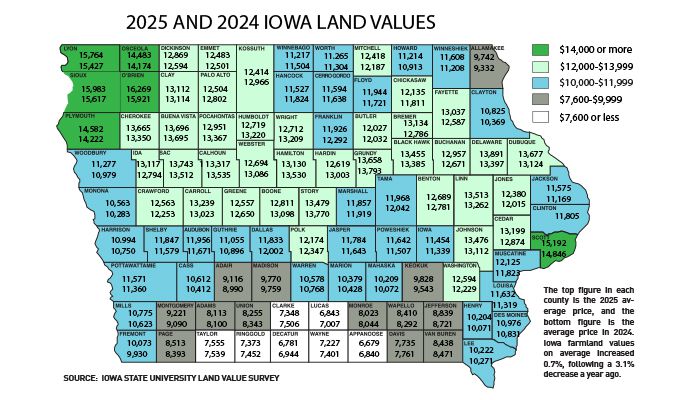
Iowa’s average farmland value increased 0.7%, or $82, to $11,549 per acre this year, marking a modest rise following a down year in 2024 that ended a five-year trend of rising land prices.
According to the annual Iowa State University (ISU) Land Value Survey unveiled this month, the nominal value of an acre of farmland increased from last year’s $11,467 but remains $286 per acre below the 2023 peak of $11,835. A year ago, values decreased 3.1%.
Rabail Chandio, assistant professor of ISU’s Department of Economics, who oversees the annual survey, said she considers changes of less than 5%, whether up or down, as more of an adjustment than a true market shift.
“Changes of that size often reflect variation across counties and crop reporting districts rather than a consistent statewide trend,” Chandio said. “It wasn’t a boom or a bust, just a very uneven adjustment, with the story changing as you move across the state.
“Strong yields, limited land supply and solid livestock income helped prop up values in some areas, but lower commodity prices, high interest rates and rising costs pulled them down in others.”
Chandio said that despite the nominal value increase, inflation-adjusted farmland values fell 1.8% this year, though the rise can still benefit farmers.
“A farmer selling land this year will receive more dollars than last year, and that can still support goals like paying down debt, transitioning to retirement or reinvesting elsewhere,” she explained.
“In that sense, the higher nominal price provides some benefit.”
When inflation-adjusted values decline, additional proceeds from land sales won’t stretch as far as they might have previously, she said.
“So while selling today can still improve a farmer’s financial position, the real economic gain is smaller than the nominal price increase suggests,” she said.
Negative, positive factors
Although farmland values increased slightly this year, Chandio said several factors applied downward pressure. Federal interest rates, which saw only modest cuts throughout 2025, continue to drag on the market.
“The market is still feeling the weight of the rate hikes from 2022 and 2023,” Chandio said. “And since interest rate effects take years, up to a decade, to be fully capitalized in land values, those post-COVID increases are still working their way through the system.”
Soft commodity prices are also putting pressure on land prices, she added, noting that tariffs likely played only a small, indirect role. Farmers are facing tight margins primarily due to low commodity prices, even with somewhat lower production costs.
Chandio noted the market is increasingly divided.
While the statewide average value increased, many counties saw declines once adjusted for inflation, and three crop reporting districts posted nominal drops.
Some counties in northeast Iowa saw increases as high as 3.4%, while central Iowa locations experienced value drops of 2% to 3%.
“Places that are more concentrated in crop production are showing not as much optimism in land markets,” she said. “Areas that are more concentrated in animal operations are showing increases this year. Livestock gains are noted as a positive influence in the land markets.”
By the numbers
Sixty of Iowa’s 99 counties recorded increases in land values this year, while78 counties reported declines in inflation-adjusted values. Land values increased across six of Iowa’s nine crop reporting districts.
O’Brien County, as in 2024, had the highest average value at $16,269 per acre, a 2.2% increase, or $348 per acre, from a year ago.
Appanoose County reported the lowest average value at $6,679 per acre, reflecting a $161 decrease from 2024. Dubuque County saw the largest dollar increase at $553 per acre, while Clayton and Allamakee counties posted the largest percentage increase at 4.4%. Kossuth County in north central Iowa experienced both the largest percentage decrease (4.3%) and the highest dollar decline ($552).
The highest average land values were reported in northwest Iowa at $14,522 per acre, while south central Iowa had the lowest at $7,823 per acre. The northeast Iowa district saw the largest percentage increase (4.1%) and the largest dollar increase ($481 per acre), while the north central district saw the largest percentage decline (2.6%) and the largest dollar decline ($315 per acre).
Statewide, low-quality land averaged $7,580 per acre, a 1.7% or $130 increase. Medium-quality land averaged $10,809 per acre, a 0.6% increase, or $69 per acre, and high-quality land averaged $14,030 per acre, a 0.7% increase, or $101 per acre.
The ISU Land Value Survey received 463 usable responses from 316 agricultural professionals, including brokers, realtors, farmers, appraisers and lenders, as well as data from land sales.
Other items of note:
• 84% of Iowa farmland is debt-free.
• People aged 65 and older own 66% of Iowa farmland.
• Existing local farmers continue to be the main buyers, followed by local and nonlocal investors.
• Retired farmers and estate sales are the main sellers in 2025.
Outlook
Of those surveyed, 61% believe current farmland values are “too high” or “way too high,” Chandio said. Respondents anticipate a slight increase in the short term, with more modest gains expected through the end of the decade.
“Most people expect farmland values to remain stable,” Chandio said.
“Within five years our respondents expect farmland values to increase much more than they expect them to decrease. Overall increases within the long-term and stability in the short-term is where most respondents feel farmland markets will land.”
Want more news on this topic? Farm Bureau members may subscribe for a free email news service, featuring the farm and rural topics that interest them most!