Record year for Iowa swans
Author
Published
3/24/2026
Trumpeter swans – adored by Iowans for their beauty and their reputation as “love birds” – are making a remarkable comeback in the state.
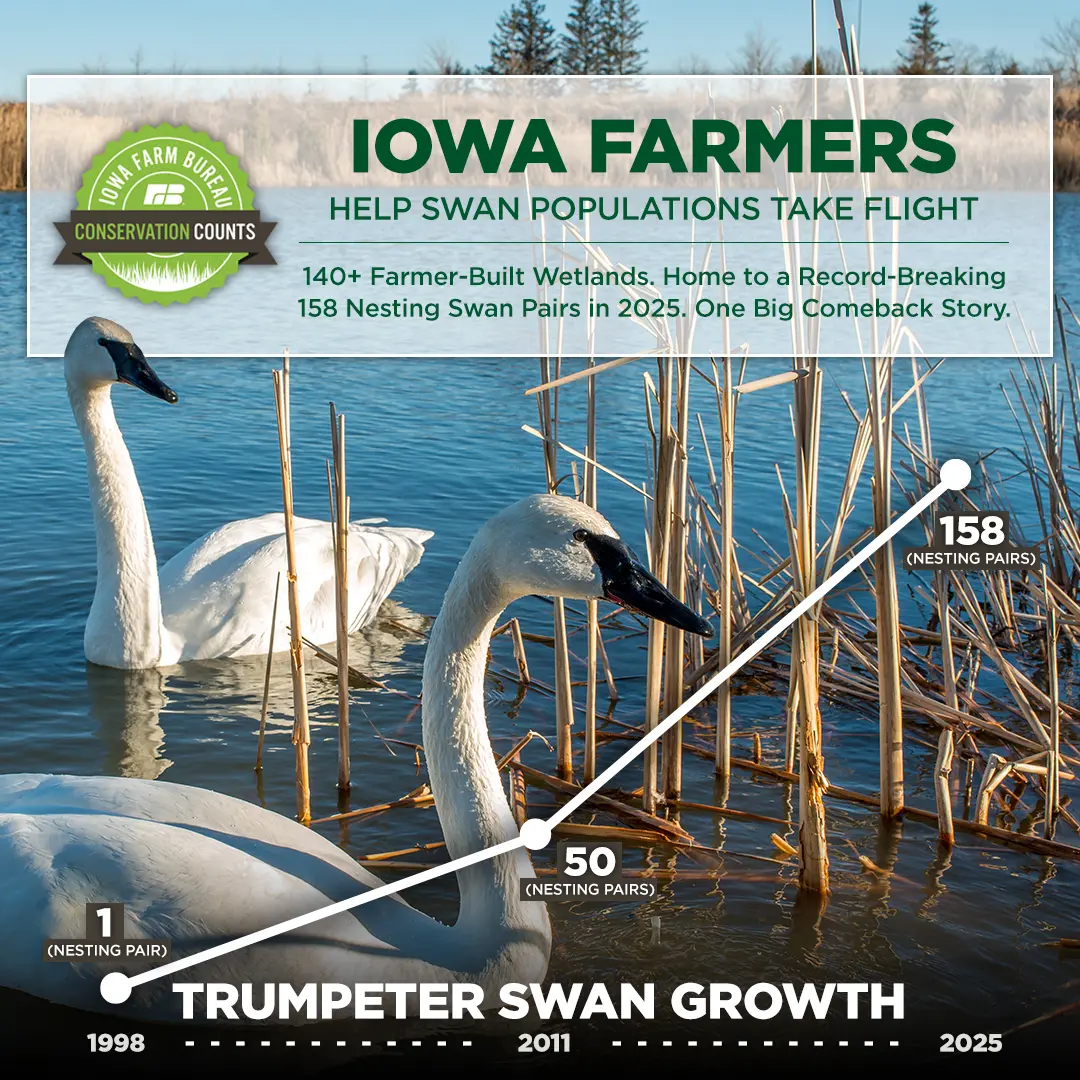
In 2025, Iowa was home to a record 158 nesting pairs of trumpeter swans, up 17% from 2022, reports the Iowa Department of Natural Resources (DNR).
“It’s an amazing success story,” says Anna Buckardt Thomas, an avian ecologist for the Iowa Department of Natural Resources (DNR). “There were zero (swans) before the 1990s, and now we’ve got 158 nesting pairs across the state, and we host over 6,000 (migrating swans) in the winter.”
Wildlife experts say more wetland habitat and cleaner water are helping trumpeter swans and other aquatic birds, such as bald eagles and cranes, thrive in Iowa.
Since the early 2000s, Iowa farmers have helped restore over 140 water quality wetlands, according to the Iowa Department of Agriculture and Land Stewardship.
Wetlands work as natural filters that can reduce nitrate runoff from farms by up to 90%. They also create habitat for native wildlife, including trumpeter swans, says Buckardt Thomas.
“Anything that private landowners can do to create or improve habitat for any type of wildlife is really important,” she says.
An ‘amazing’ comeback
Trumpeter swans are native to Iowa and were once abundant, but they were hunted to extinction in the late 1800s, traded overseas for their feathers and meat.
More than a century later, in the mid-1990s, the Iowa DNR reintroduced five nesting pairs of trumpeter swans to the state. By the early 2000s, the number of Iowa swans grew to about 25 nesting pairs.
Today, trumpeter swans are thriving in Iowa. They are nesting and migrating independently, without human intervention, Buckardt Thomas says.
“We’ve got plenty of good wetland habitat for (swans), more than we have for the number (of swans) in the state right now. There’s definitely room to support growth of the population,” Buckardt Thomas says.
Tracking the trumpeters
Last summer, Iowa State University (ISU) researchers launched a study to track swans and other wildlife in constructed water quality wetlands in Iowa.
The study was funded by the Iowa Department of Agriculture and Land Stewardship, as part of the Iowa Conservation Reserve Enhancement Program (CREP).
Since 2002, the CREP program has provided state and federal funding to help Iowa landowners build wetlands on private land. The program’s goal is to build wetlands that can capture and reduce nitrate runoff from cropland to streams and rivers.
Last summer, ISU graduate research assistant Jayden Jech visited 81 of these constructed wetlands across the state.
His research found that about 25% of the constructed wetlands housed swans, for a total of 20 nesting pairs.
And these swans aren’t in remote areas. Wetlands are built on the edge of working farm fields, so the swans are nesting close to where farmers plant, grow and harvest.
“Farmers will contact me and send updates and photos, tracking the progress of the cygnets (young swans). They are very involved and protective of the swans,” Jech says.
Expect more swans in Iowa
Iowans can expect to see more trumpeter swans as wetland habitat continues to expand.
Over 90 new wetland construction projects are now planned for 2026 and beyond, according to the Iowa Department of Agriculture and Land Stewardship.
Not only do the wetlands benefit water quality, they also attract all kinds of native wildlife – including swans, rare turtles, marsh birds and reptiles, explains Adam Janke, ISU Extension wildlife specialist.
“It’s supporting the recovery of this charismatic bird that people love to see, and the water is getting cleaner because of it. It’s an amazing story to tell,” Janke says.
Jech said the farmers he’s met during his wetland visits take a lot of pride in providing habitat for the swans.
“I’ve been able to show farmers the birds on their wetlands, and they are very excited to learn more. It’s a really cool partnership with hundreds of farmers across the state,” Jech says.
Iowa farmers are committed to environmental responsibility, making sure the water our families – and their families – drink is safe. To learn more about water quality wetlands and how they work, visit conservationcountsiowa.com.
And for more information about Iowa’s CREP wetlands program for landowners, including eligibility and enrollment, visit iowaagriculture.gov/crep.
Return to The Iowa Dish
Want more news on this topic? Farm Bureau members may subscribe for a free email news service, featuring the farm and rural topics that interest them most!