Digging into Iowa’s ‘hidden’ nitrate filters
Author
Published
4/9/2026
As a farmer and excavating contractor, Farm Bureau member Jacob Handsaker knows we often need to look beneath the surface to understand what’s happening – especially when it comes to farmers’ efforts to protect nearby streams from nitrate runoff.
It’s Jacob’s job to construct practices that act as “hidden” edge-of-field nitrate filters, like the saturated buffer I watched him build in Story County last month.
Above ground, a saturated buffer looks like nothing more than a grassy strip between a field and stream. Underground, it’s a different story.
“This saturated buffer will operate like a big sponge,” Jacob told me. “As that water moves through the soil profile, nitrates and phosphorus are removed before that water enters our streams.”
Saturated buffers are part of a broader family of edge-of-field practices specifically designed to filter nitrates before they reach streams. Others include:
- Bioreactors
- Multi-purpose oxbows
- Water quality wetlands
Iowa State University research shows these practices filter out, on average, roughly 50 percent of the nitrates that flow through them – and often much more, according to Handsaker.
Because these practices blend into the landscape, it’s easy to overlook just how quickly they’ve expanded across Iowa, as farmers work diligently to protect water quality.
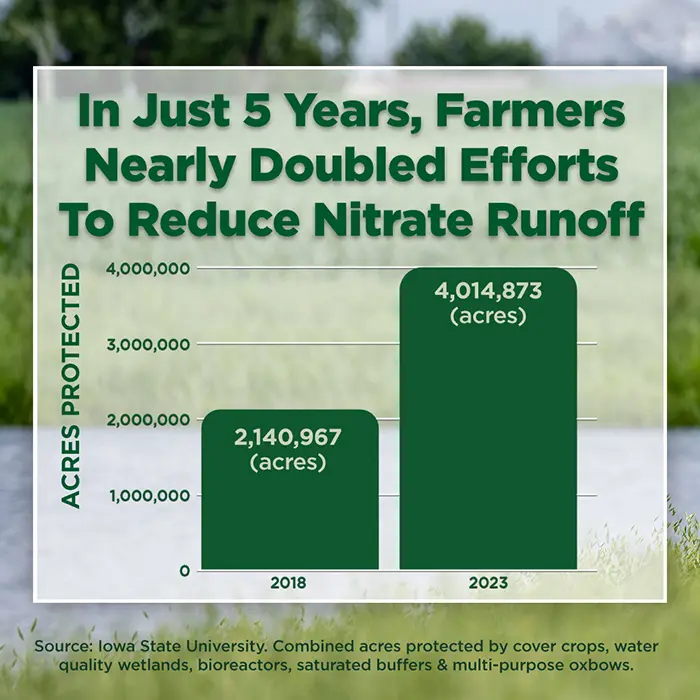
According to ISU, Iowa farmers have nearly doubled the acres protected by five key conservation practices that capture and filter nitrates in just five years – a sign of rapid momentum. These practices include the four listed above and cover crops (an in-field practice farmers use to hold soil in place and prevent runoff).
Twelve years ago, Handsaker said his company might wait three years to install just one edge-of-field practice. Now, thanks to streamlined processes and growing farmer demand, his team will build more than 50 this year alone.
“We’re showing time and time again that they work. Saturated buffers, bioreactors, wetlands – whatever you want to put in place to protect water quality matters,” he said. “Farmers are at the forefront of getting this done. And it’s really cool to watch.”
Whether we see them or not, these hidden practices are quietly doing critical work – put in place by farmers who are taking real, hands-on action to protect Iowa’s waterways.
Want more news on this topic? Farm Bureau members may subscribe for a free email news service, featuring the farm and rural topics that interest them most!