PD 2026: Windbreak Incentives (State)
In Iowa, there are two primary options that provide financial incentives for windbreaks, aimed at preventing snow from drifting along roads. The first is the “Iowa Cooperative Snow Fence Program” administered by the Iowa Department of Transportation (DOT) that offers compensation to farmers and landowners for various types of windbreaks and snow fences. The United States Department of Agriculture’s (USDA) Conservation Reserve Program (CRP) also has the “Living Snow Fence” practice available.
Iowa Cooperative Snow Fence Program
The Iowa Cooperative Snow Fence Program compensates farmers for leaving rows of standing corn, standing bales of hay, or corn stalks along highways to function as windbreaks. It also provides incentives for structural fence options to prevent snow drifts. The program typically covers 50 to 80 miles of highway annually, preventing dangerous drifts and improving winter driving conditions. Program options include:
- Standing Corn Fence: Farmers leave six to twenty-four rows of corn standing after harvest, typically on the north or west side of roads to stop drifting. Corn can be hand harvested from corn stalks in the fall or in the spring before planting. DOT pays the farmer/landowner based on the corn’s assumed yield with the price per bushel based on the statewide average cash price on August 1 each year, plus $2.00 per bushel. Agreements run from fall to spring and can be renewed annually.
- Standing Bale: Farmers line up hay or corn stalk bales end to end, parallel to the edge of the roadway. The DOT pays $1.00 per linear foot of bale running parallel to roadway.
- Structural Fence: The program also includes incentives for permanent or temporary structural snow fences. Permanent snow fences are six to eight feet tall, run parallel to the road, and require agreements with DOT that are a minimum of five years. DOT pays $1.00 per linear foot of permanent fence. Temporary snow fences are four feet tall portable fences made of plastic or wood and can be installed by the landowner or DOT after harvest. Agreements for temporary fencing go from fall to spring annually.
CRP Living Snow Fence
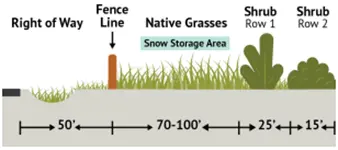
The Conservation Reserve Program (CRP) provides a “Living Snow Fence” practice designed to set aside land as a living snow fence. This practice (CP17A) is available under Continuous CRP and allows the landowner to receive 50% cost share for establishment costs plus annual payments for up to fifteen years if they agree to plant two rows of trees, or a combination of trees and shrubs, along with seventy – one hundred feet of native grasses such as illustrated below.
Discussion Questions:
- Do you, or people you know, participate in any windbreak programs to prevent snow drifts?
- Do you know of areas in need of windbreaks to prevent snow drifts?
- Are incentives for windbreaks sufficient or could they be improved?